








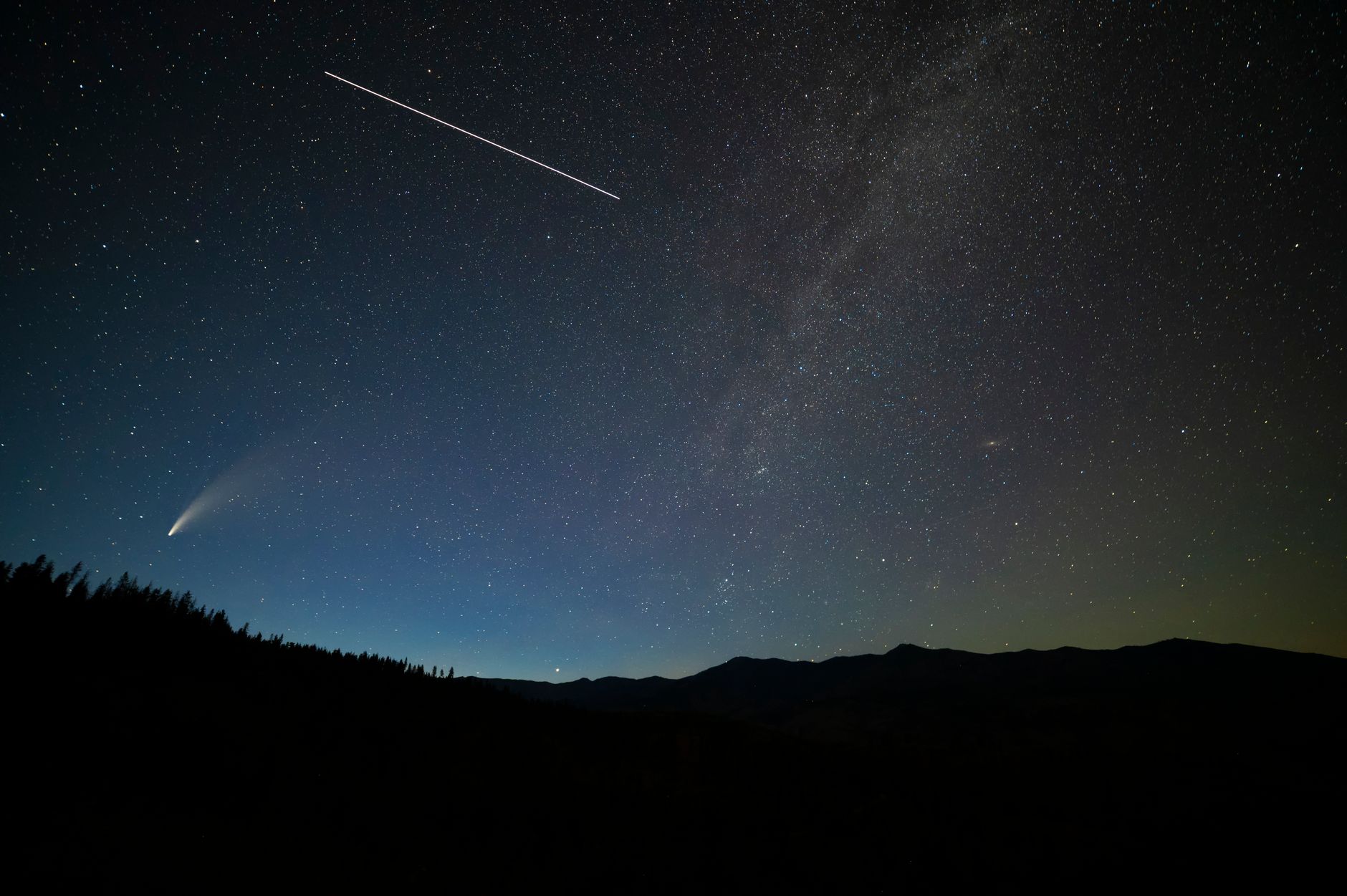
Halley’s Comet meteors will be visible on Oct. 22, offering a rare opportunity for skywatchers. Early risers can enjoy this celestial show.
What are Halley’s Comet meteors?
Halley’s Comet meteors, also known as the Orionids, are a spectacular celestial event that occurs each year. These meteors are remnants of Halley’s Comet, which last passed close to the Earth in 1986. As the Earth orbits the Sun, it passes through the debris left behind by the comet, resulting in a dazzling display of shooting stars.
The Orionids are typically visible from early October to early November, with the peak occurring around mid to late October. During this time, observers can expect to see an increase in meteor activity, with rates reaching up to 20 meteors per hour under ideal conditions. These meteors are known for their bright, fast streaks across the night sky, making for a breathtaking sight.
To catch a glimpse of Halley’s Comet meteors, find a dark location away from city lights. Look towards the constellation Orion, as the meteors appear to radiate from this area. Prepare for the show by allowing your eyes to adjust to the darkness, enhancing your chances of witnessing this celestial phenomenon.
When to watch for the meteors
The best time to watch for meteors from Halley’s Comet is during the early morning hours, particularly on October 22. During this period, the Earth passes through the debris left behind by the comet, resulting in a spectacular meteor shower. To maximize your viewing experience, it is recommended to find a dark location away from city lights.
Here are some tips for a successful meteor watching experience:
- Check the weather: Clear skies are essential for optimal viewing.
- Arrive early: Get to your location well before the peak viewing time to settle in.
- Be patient: Meteors can appear sporadically, so allow time for your eyes to adjust to the darkness.
- Stay comfortable: Bring blankets or reclining chairs to enjoy the show without discomfort.
For those eager to witness this celestial event, the early hours of October 22 will be the prime time to see Halley’s Comet meteors streaking across the sky.
Best viewing tips for meteor showers
To fully enjoy the spectacle of Halley’s Comet meteors, there are several key tips to enhance your viewing experience. First, find a location away from city lights where the sky is dark and clear. Light pollution can significantly diminish your ability to see these celestial events.
Second, check the weather forecast ahead of time. Cloudy skies can obstruct your view, so aim for a night with clear conditions. It’s also beneficial to allow your eyes to adjust to the darkness for about 20 to 30 minutes.
Third, consider timing your observation. The best viewing period is often in the early morning hours when the sky is darkest. This year, on October 22, set your alarm early to catch the peak activity of these meteors.
Lastly, bring along a comfortable blanket or reclining chair to sit back and enjoy the show. Don’t forget to dress warmly, as temperatures can drop significantly at night.
With these tips, you’ll be well-prepared to witness the stunning Halley’s Comet meteors in action!
The science behind Halley’s Comet
Halley’s Comet, a celestial body known for its spectacular appearances, orbits the sun every 76 years. When it approaches the sun, it sheds particles that create the meteor showers we can observe from Earth. These particles, tiny remnants from the comet, enter our atmosphere at high speeds, leading to the brilliant streaks of light we refer to as Halley’s Comet meteors.
The science behind this phenomenon lies in the comet’s composition. As it travels through the inner solar system, the heat from the sun causes the comet’s icy nucleus to sublimate, releasing dust and gas. This debris trails behind the comet in its orbit, creating a path of meteor showers that we can encounter when Earth crosses this trail.
Notably, the most prominent meteor shower associated with Halley’s Comet is the Orionids, which peaks in late October. Observers can witness these meteors, characterized by their swift movements and bright appearances, providing a spectacular show in the night sky.
Historical significance of Halley’s Comet
Halley’s Comet has captured human imagination for centuries, leaving a lasting mark on history and culture. Its periodic returns have been observed and documented since ancient times, with records dating back to 240 B.C. This celestial body, which orbits the Sun approximately every 76 years, is not only significant for its appearances but also for the stunning meteor showers it produces, known as the Halley’s Comet meteors.
Throughout history, the comet’s return has been associated with various events, from the fall of empires to significant battles. For instance, the appearance of Halley’s Comet in 1066 was interpreted as a bad omen by the Anglo-Saxons, coinciding with the Norman Conquest of England. Such historical associations have cemented its place in our collective consciousness.
Furthermore, its visibility has inspired countless works of art and literature, making Halley’s Comet a symbol of both wonder and fear. As we prepare to witness the meteor showers it generates, the historical significance of this celestial marvel continues to resonate with us today.
How to prepare for early morning viewing
To fully enjoy the spectacle of Halley’s Comet meteors, preparation is key. Here are a few essential tips to ensure a successful viewing experience:
- Choose a dark location: Find a spot away from city lights and pollution. Parks or open fields make excellent choices.
- Check the weather: Clear skies are ideal for meteor watching. Look at local forecasts to avoid disappointment.
- Bring the right gear: A comfortable blanket or reclining chair can enhance your viewing experience. Don’t forget warm clothing and perhaps a thermos of hot drink.
- Be patient: Meteors may not appear immediately. Allow yourself at least an hour for the best chance of spotting the Halley’s Comet meteors.
- Use your eyes: While binoculars or telescopes can be helpful for stargazing, the best view of meteors is often with the naked eye.
With these tips in mind, you’re all set for a breathtaking early morning display of Halley’s Comet meteors!
Gathering the right equipment for stargazing
To fully enjoy the spectacle of Halley’s Comet meteors, gathering the right equipment is essential. While the beauty of the meteors can be appreciated with the naked eye, having some tools can enhance your experience.
- Binoculars or a telescope: These can help you see the meteor showers more clearly, especially if you are interested in observing specific celestial features.
- A comfortable chair or blanket: Since meteor watching often requires long periods of sitting or lying down, having a cozy spot will make the experience much more enjoyable.
- Warm clothing: Early morning temperatures can be quite chilly, so dressing in layers will keep you comfortable.
- Star charts or apps: Familiarizing yourself with the night sky can add to the excitement of spotting Halley’s Comet meteors as they streak across the heavens.
- A thermos with hot drinks: Staying warm from the inside out will help keep your spirits high during the wait for meteors.
With the right preparation, you can fully immerse yourself in this celestial event.
Other upcoming astronomical events
In addition to the Halley’s Comet meteors, astronomy enthusiasts can look forward to several other exciting celestial events in the coming months. Here are some noteworthy occurrences:
- Leonids Meteor Shower: Peaking around November 17, the Leonids are known for their fast and bright meteors, originating from Comet Tempel-Tuttle.
- Geminids Meteor Shower: Set to peak on December 13-14, this is one of the most prolific meteor showers, offering a chance to see up to 120 meteors per hour.
- Quadrantids Meteor Shower: Occurring in early January, the Quadrantids can deliver a spectacular display, particularly around January 3.
- Occultations and Conjunctions: Various celestial events, such as planets passing in front of stars or aligning closely with one another, will also take place throughout the winter months.
Each of these events provides a unique opportunity to experience the wonders of the night sky, making them perfect for stargazers eager to witness Halley’s Comet meteors and beyond.
Photo by Frank Cone on Pexels